
Previous Section: The Causes of Emigration, § 9
Next Section: The Causes of Emigration, § 11
§ 10
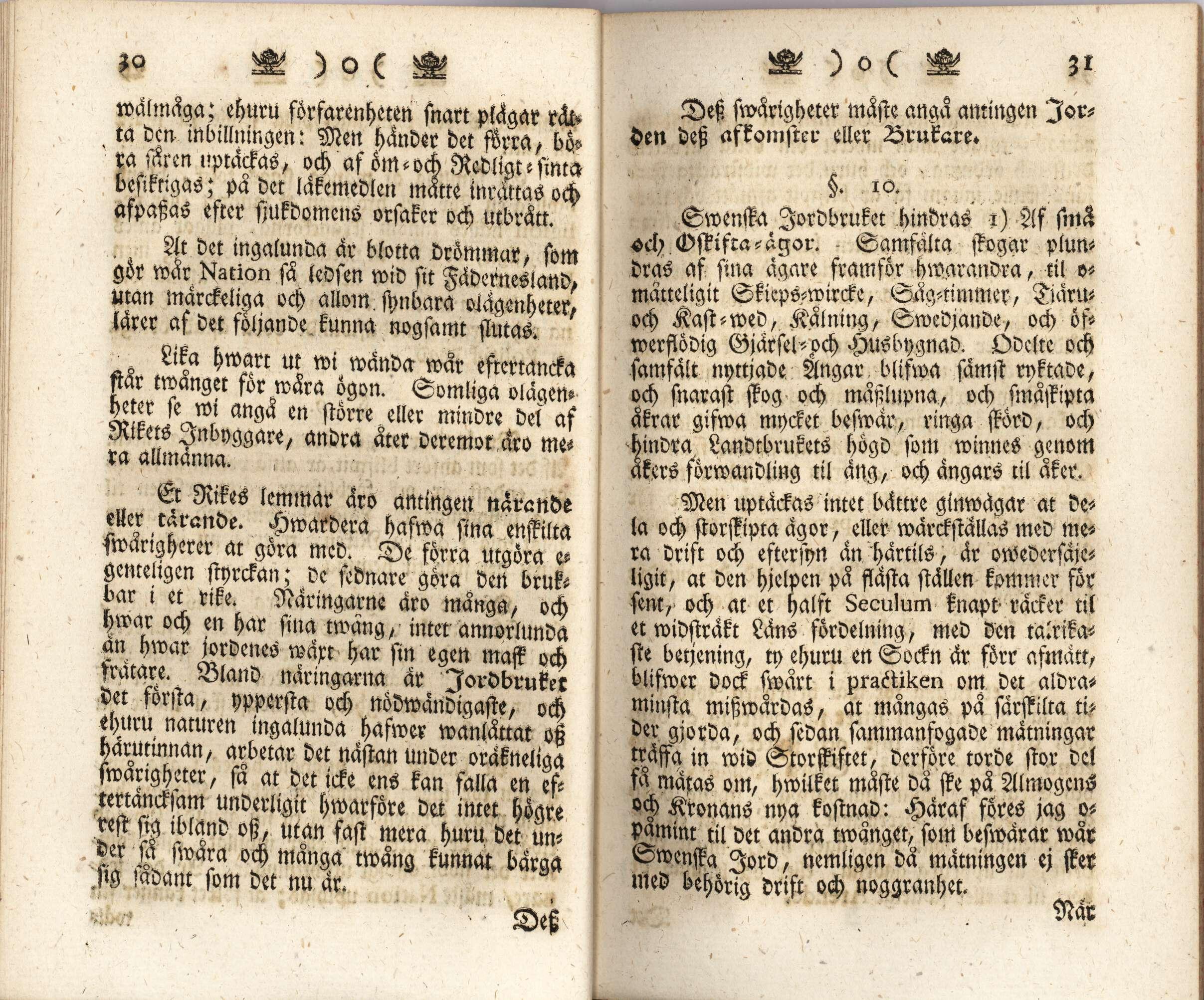
The first obstacle facing Swedish agriculture is that of small and unredistributed holdings.1 Communally owned forests are openly plundered by their owners at the expense of their co-owners to produce excessive amounts of ship-timber, saw-timber, tar-wood, firewood, for charcoal burning, slash-and- burn farming and superfluous fencing and house-building. Unredistributed and collectively utilized pasture land is the worst maintained and more like woodland and moss-grown, while small plots cause a great deal of trouble, produce poor crops and prevent the improvement of agriculture that is achieved by turning arable land into meadow and meadows into arable land.
But unless a more expeditious way is found of dividing and redistributing holdings, or it is pursued more energetically and with better supervision than hitherto, that improvement will indisputably come too late in most places, and half a century will barely suffice to redistribute the land in an extensive county even with the maximum number of staff. For even if a parish has been surveyed previously, it will nevertheless be difficult in practice, if the slightest error has been committed, to make sure that the measurements made by many individuals at different times and then joined together will be accurate at the stage of general redistribution, so that a large part is likely to need to be re-surveyed, which must then be done at an additional cost to the rural population and the Crown. This leads me directly to the second constraint that afflicts our Swedish land, namely when the surveying is not carried out with due dispatch and accuracy.32
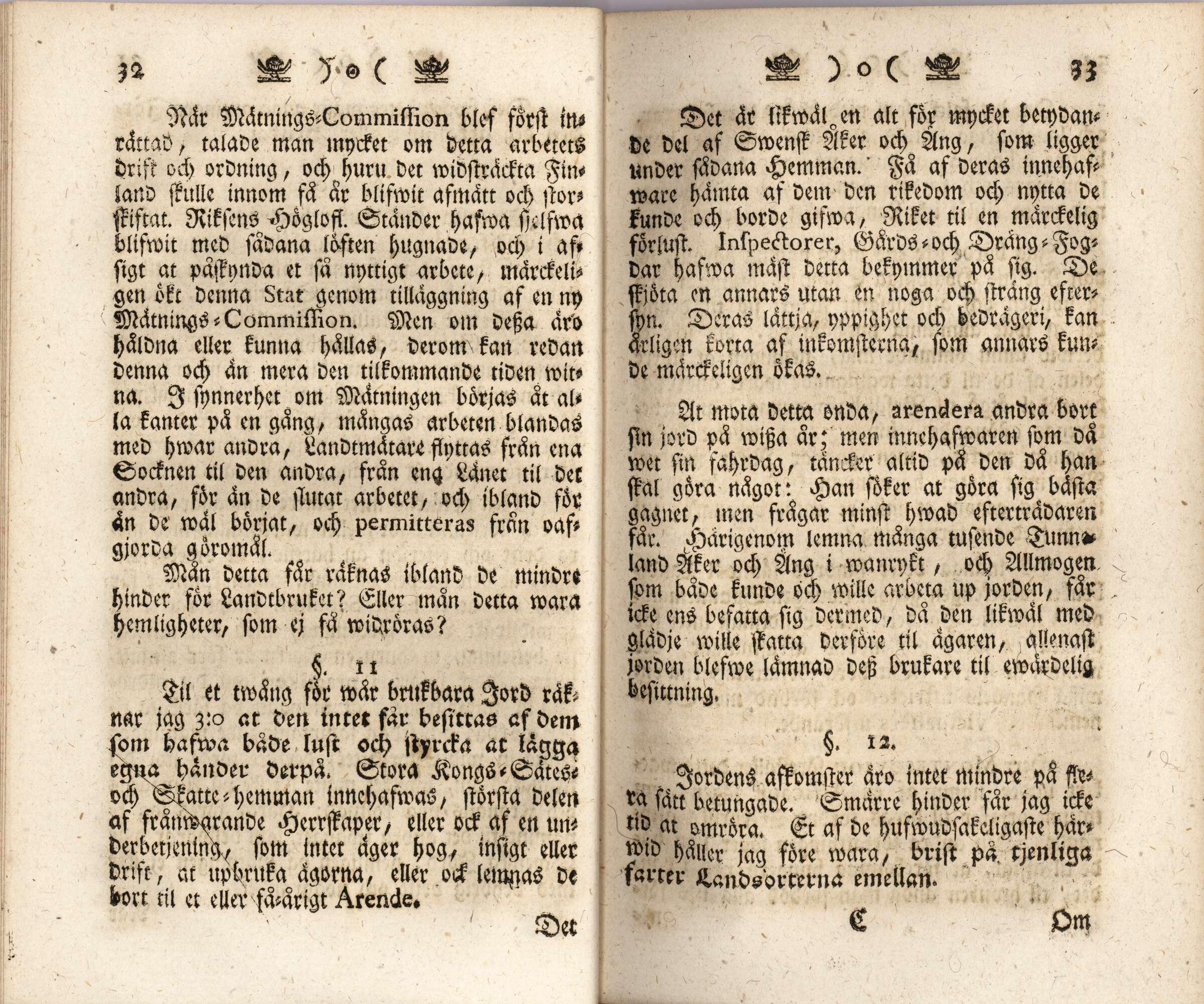
When the Survey Commission was first established there was much talk of the energy and orderliness of this work and how the far-flung Finland would within a few years be surveyed and undergo a general redistribution of land holdings. The honourable Estates of the Realm were themselves regaled with such promises and, in order to expedite such a useful project, notably enlarged the establishment by adding a new Survey Commission. But whether those promises have been or can be kept, the present and still more the coming period will bear witness – especially if the survey is begun simultaneously in every region, the work of many different individuals is amalgamated, surveyors are transferred from one parish to another, from one county to another, before they have completed their work, and sometimes before they have even begun, and are granted leave with their tasks unfinished.
Could that be regarded as one of the lesser obstacles for agriculture? Or are these secrets that must not be discussed?