Previous Section:
Next Section:
[1]
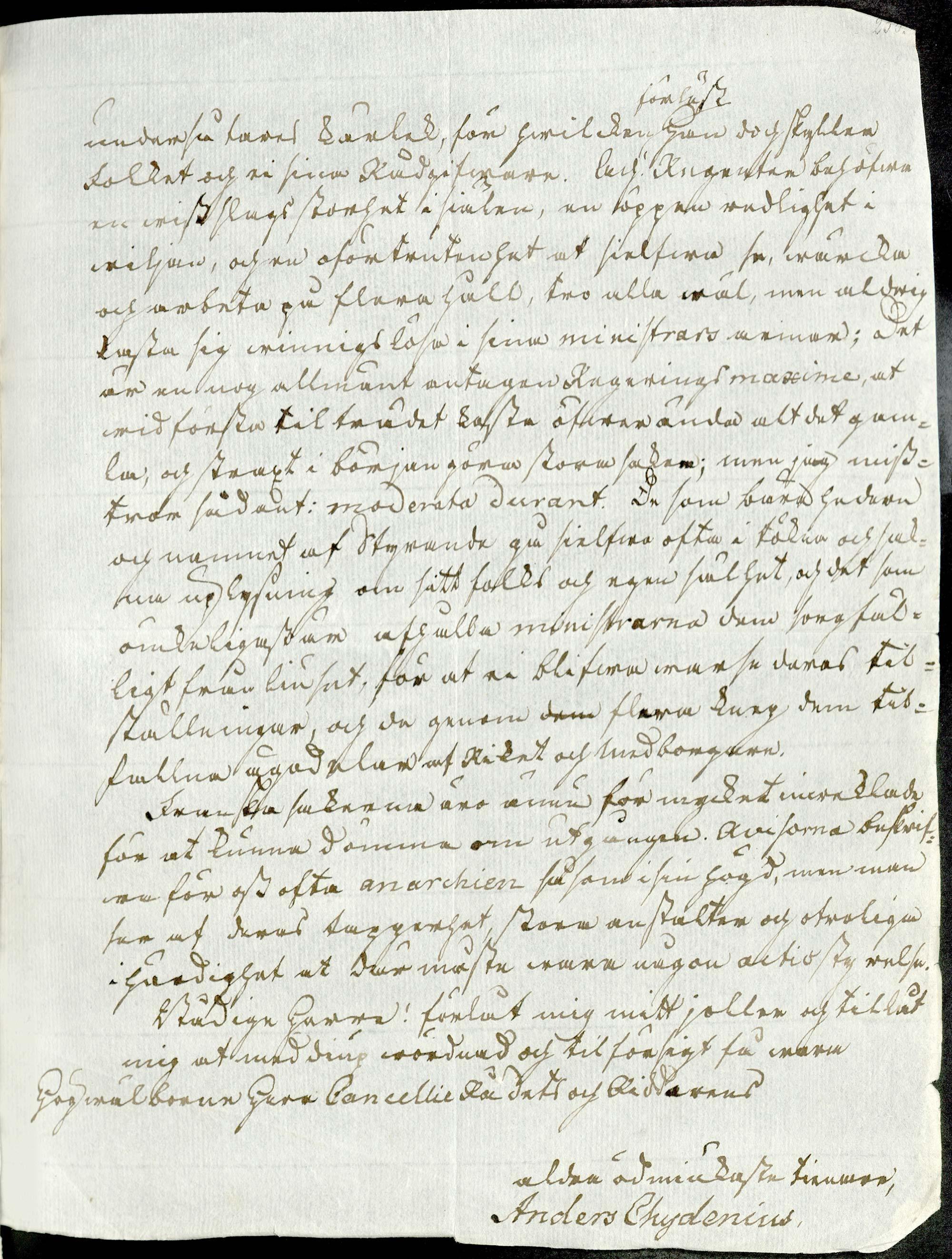
Kokkola, 21 August 1793.
Right Honourable Chancery Councillor and Knight of the Order of the Polar Star.1
Gracious Sir,
My attention having already been drawn, Your Honour, by a review in Stockholms-Posten to Your treatise on the Enlightenment,2 thorough far beyond my powers of praise, I was quite taken aback when a copy of it was delivered to me at the behest of Mayor Fagerström,3 with the message that it had been sent to me by Your Honour, before I had time to order it from the bookshop.[2] I thank you most humbly for the gift, without any prospect or hope of ever being able to show my gratitude. But it is not the value of the book, not even its exhaustive contents nor even the appeal of the subject itself, although it has been my favourite topic ever since I began to think, and which has never been so thoroughly investigated as here, which has aroused the most profound respect and admiration with which my heart overflows. No, it is something else, namely to be remembered by the principal defender of the freedom of thought and the enlightenment in the North, who, despite the forces of darkness and their intrigues, with the ardour that should accompany the truth that is a fundamental necessity for society and the clarity that alone can produce an unshakable conviction, has dared to speak the language of truth at the very time when the concepts of the utility of the enlightenment for the maintenance of societies have come under all too great pressure from delusional ideas and high-handedness throughout Europe, and who is in the arduous yet fortunate position of being able to impress and strengthen such concepts in Him4 who within three years (God preserve the king) will make himself great and his people happy by means[3] of the enlightenment.
Your Honour’s topic has ever since 1762 attracted my attention when I first read the works of the Board of Trade Counsellor Nordencrantz, since which time I have laboured for the enlightenment within my small circle, especially during the Diet of 1765, when, as a member of the Committee on the Freedom of the Press in 1766, I contended with the then censor, Permanent Secretary Oelreich, and secured the support of the estates of the peasants and the burghers against the most powerful that be to abolish the censorship and was able myself, a few days before I was voted out of the estate for my System of Finance,5 to draw up the memorial6 that gained the approval of the Grand Joint Committee before I left Stockholm, with the words of Epaminondas in my mind: Satis vixi, invictus enim morior.7
Several years ago, when, if I remember correctly, the Berlin Academy of Sciences8 proposed a question as to whether the enlightenment is useful or harmful for the subjects of a kingdom, I felt indignant in my soul to hear that learned society give the highest prize to two individuals, of whom one answered the question in the affirmative and the other in the negative, without having been able to read either reply. I have, however, with complete satisfaction ventured to take a lead for freedom against prejudices in those branches that I have managed to reach and have opposed secrecy and compulsion with regard to staple commerce, the commodity act, rural trade, monetary policy and the distribution of servants[4] by lots etc. But when a few years ago I observed streams of blood flowing under the banner of enlightenment and freedom and under the sacred name of the enlightenment a frenzy of high-handedness rapidly spreading around the whole of Europe, which threatened rulers, subjects and citizens alike with the most terrible anarchy my conviction (I must confess it frankly) began to waver and what had formerly been fundamental truths for me to trouble me with regard to their correctness, from which Your Honour may easily conclude how satisfactory Your treatise was for me, who neither had the time, the understanding nor the strength to investigate a complex of matters that has become so hopelessly tangled in our time.
Why then are the rulers of Europe so sensitive to the light? Why wish to be regarded as infallible and not tolerate contradiction? The one who mocks will have to pay the penalty for his crime, and a lie can always be refuted, but when genius, truth and patriotism remain under the guardianship of the printer and he for the sake of his safety under the infallible divinity of the ministry, then the voice of truth falls silent, the patriot groans and those in authority forge fetters in the dark and flatter the ruler with promises of the earth and the moon, until he realises that he has lost what is most precious and constitutes his essential greatness,[5] the love of his subjects, for the loss of which, however, he blames the people and not his advisers. Alas! Rulers need a certain kind of greatness in their soul, a candid probity in their will and an indefatigability in personally supervising, acting and striving in various domains, thinking well of everyone but never throwing themselves gainlessly into the arms of their ministers. It is an almost universally accepted maxim of government to overturn all the old at the first opportunity and from the very beginning perform great things; but I distrust such things: moderata durant.9 Those who bear the honour and name of rulers are often themselves shrouded in mist and lack understanding of the happiness of their people and themselves, and what is most pathetic, their ministers studiously keep them in the dark, in order that they do not become aware of what the ministers bring about and of the possessions of the kingdom and its citizens that have by means of various subterfuge fallen into the ministers’ hands.
The French affairs are still too complicated for one to be able to anticipate the outcome. The newspapers often describe for us the anarchy as being at its peak, but one sees from their courage, great undertakings and incredible tenacity that there must be some active leadership there.
Gracious Sir! Excuse my prattle and allow me with deep respect and assurance to be Your Honour’s
most humble servant,
Anders Chydenius.